AR
Manuscript of Nahj al-Balagha 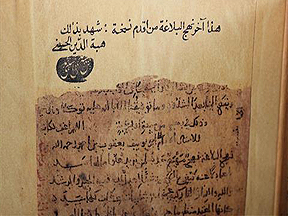
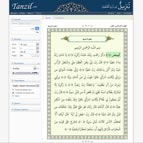
The Al al-Bayt Foundation for the Revival of Heritage, under the patronage of Hujjat al-Islam wal-Muslimin Sayyid Jawad al-Shahristani (may his honor endure), had the honor of printing the oldest manuscript of *Nahj al-Balagha*. We have selected the following excerpt from the introduction for you.
The book *Nahj al-Balagha* has, over the past thousand years, received the attention and care of various academic institutions, research centers, cultural foundations, intellectual circles, scholars, and specialists through commentary, annotation, verification, analysis, and study.
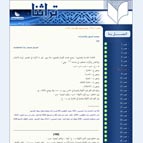
Naturally, the number of manuscripts and editions of *Nahj al-Balagha* has increased to the point where counting them becomes difficult. The late esteemed scholar Sayyid Abd al-Aziz al-Tabataba’i (may his soul be sanctified) made a great effort to document as many manuscripts of *Nahj al-Balagha* as possible, recording his findings in articles published in *Turathuna* magazine (see *Turathuna*, Year 1, Issue 5, 1406 AH; Issues 2 and 3, Year 2, 1407 AH), published by the Al al-Bayt Foundation for the Revival of Heritage.
Among the manuscripts he referenced is the one currently before the discerning reader, which he titled “The 5th-Century Manuscript.” This copy was housed in the library of Ayatollah Sayyid Hibat al-Din al-Shahristani (1301–1386 AH), known for its precious manuscripts and valuable books. After his passing, it remained in the possession of his distinguished son, the esteemed lawyer Sayyid Jawad, a man of notable social standing.
According to *Al-Murshid al-Baghdadi* magazine, this is the oldest handwritten copy, dating back nearly a thousand years. The style of script and condition of the pages also attest to its great antiquity, with some letter forms closely resembling early script styles.
Ancient Arabic Kufic Script
The author frequently notes in the book’s margins phrases or additions copied from a version written during the compiler’s lifetime. Besides its antiquity, this manuscript is distinguished by preserving those additions found by the scribe. Three pages are missing from the beginning of the book—specifically from one of al-Sharif al-Radi’s sermons (may God have mercy on him). The extant text begins with the phrase: *“al-Abdāl—and these are among his wondrous virtues and gentle qualities,”* and so on. The author’s name is missing from the end of the book, but the date of copying remains: *“in Rajab of the year four hundred... may God forgive its scribe.”*
The manuscript measures 18 cm in length, 15 cm in width, and 2 cm in thickness. The phrase *“From a sermon of his (peace be upon him)”* and some margin notes are written in red ink. At the end of the book is a stamp, partially legible, reading either *“Al-Mu‘izz li-Amr Allah”* or *“Al-Mu‘tazz bi-Amr Allah al-Taqi”* or *“Al-Radi.”* The stamp is in Ruq‘ah script. This is all that could be deciphered from this valuable artifact.
The respected scholar Sayyid Jawad, son of Sayyid Hibat al-Din al-Shahristani (may God sanctify his soul), remarked that what the magazine once stated is now difficult to verify, due to the script’s age. The manuscript consists of over 350 pages, most filled on all sides with commentary and interpretations by prominent scholars. The handwriting remains quite clear despite the manuscript’s age. The lines measure 10.5 cm across, the text block is 14 cm tall, and each page contains 19 lines.
Both the Italian orientalist Carlo Anellino and the French orientalist Louis Massignon viewed the manuscript during their visit to Iraq in the early 1930s. They admired the book, its annotations, and its valuable additions, and praised its rarity. Massignon noted their willingness to offer over three thousand dinars to acquire it at the time, due to the scarcity of such manuscripts.
However, upon personally examining the manuscript in detail, the exact date of writing and the name of the scribe could not be confirmed—raising doubts about whether it truly dates back to the 5th century AH. Nonetheless, this does not diminish its value or significance, especially since experts such as Sayyid Hibat al-Din al-Shahristani and Sayyid Abd al-Aziz al-Tabataba’i (may God bless them) affirmed its authenticity.
It is possible that evidence points to it being a manuscript from the 6th century AH. And God knows best.
...